Home › Resources › Pico vs Q-Switched Laser
Pico vs Q-Switched Laser: Which Pigment and Tattoo Laser Fits Your Med Spa?
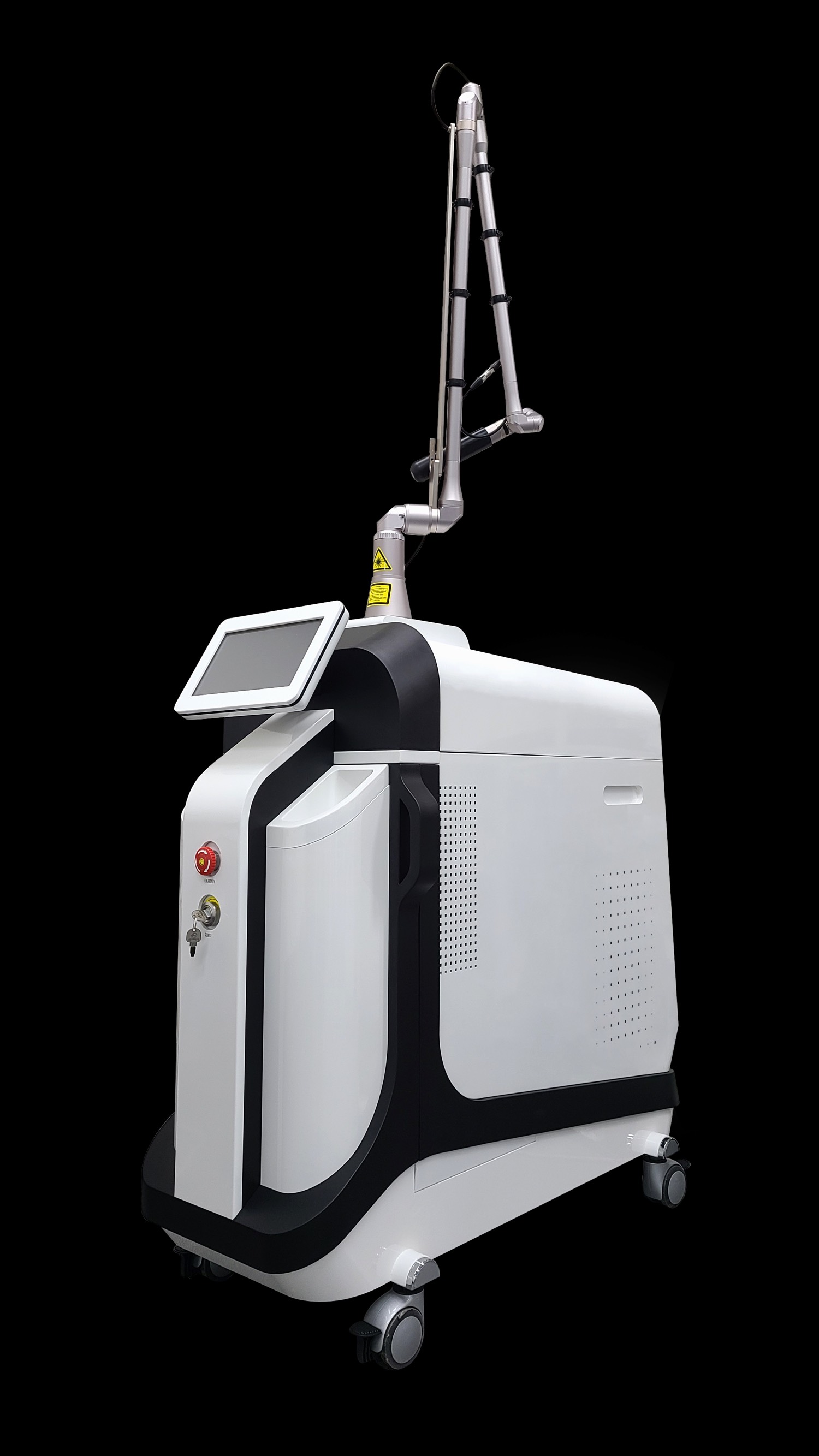
If you add tattoo removal, pigment or laser toning to your menu, you will choose between two kinds of Nd:YAG laser. A Q-switched laser fires pulses in the nanosecond range. A picosecond ("pico") laser fires pulses about a thousand times shorter. Vendors on both sides make big claims, so this guide sticks to what published studies actually found and what that means for a med spa, dermatology or plastic surgery practice.
We sell both kinds: PICO PREMIUM, a 300 ps picosecond Nd:YAG, and Q10 PREMIUM, a Q-switched and long-pulse Nd:YAG. So treat this as our view, and check the linked studies yourself. We make no claims about results from either IDS device, and we don't publish device prices. Request pricing and we'll quote either one.
The short version
- Both are proven for black and blue ink. A JAAD systematic review of 36 studies found Q-switched Nd:YAG and picosecond lasers both safe and effective for black tattoos [S1].
- Pico shows its edge on some colors. The same review found picosecond lasers superior for blue, green and yellow tattoo pigment [S1].
- Fewer sessions is possible, not guaranteed. A 2026 systematic review of 46 Nd:YAG studies found pico systems "may achieve similar clearance with fewer sessions or lower fluence," but did not find consistent superiority over Q-switched Nd:YAG [S2].
- For melasma, the trials found no clear winner. Split-face trials comparing 1064 nm pico and Q-switched toning found no statistically significant difference in melasma scores. Two of them found pico less painful [S4][S5][S6].
- The business question is your menu. If tattoo removal with colored ink is a big part of it, pico has the stronger evidence. If your menu is pigment, toning, carbon peels and also hair or vascular work, a Q-switched platform with a long-pulse mode covers more services on one console.
How the two lasers work
Both lasers target pigment by selective photothermolysis: a short, intense pulse is absorbed by ink or melanin and breaks it into smaller particles that the body clears over time. The difference is pulse length.
A Q-switched laser stores energy and releases it in a nanosecond pulse. This has been the standard tattoo and pigment laser for decades.
A picosecond laser releases energy in picoseconds (trillionths of a second). The shorter pulse puts more of the effect into a mechanical, photoacoustic shock rather than heat, which is the reason vendors give for less heat spread to surrounding tissue.
The classic test of this idea was a 1998 Harvard/MGH study. Researchers treated two halves of the same black tattoo with 35 ps and 10 ns Nd:YAG pulses, holding everything else the same. In 12 of 16 tattoos, the picosecond side lightened significantly more. Non-black colors responded about the same to both [S3]. That study used research lasers, not today's commercial systems, but it is why pulse duration became the headline spec.
What the studies show
| Question | What the research found | Source |
|---|---|---|
| Black tattoos | Both Q-switched Nd:YAG and pico are safe and effective | [S1] |
| Blue, green and yellow tattoos | Picosecond lasers showed superiority | [S1] |
| Number of sessions | Pico may reach similar clearance with fewer sessions or lower fluence; not consistent across studies. Nd:YAG generally needed 4 to 8 sessions to reach 75% or more clearance of black and blue ink | [S2] |
| Quality of the evidence | Rated low to very low certainty; studies vary widely in design and how they measure clearance | [S2] |
| Melasma (1064 nm toning) | No statistically significant difference between pico and Q-switched in three split-face trials | [S4][S5][S6] |
| Comfort | Pico was less painful in two melasma trials [S5][S6]; one found no difference in pain scores [S4] | [S4][S5][S6] |
| Side effects | Mostly mild and temporary, mainly changes in pigment | [S2] |
Two cautions before you put any of this in front of patients. First, the melasma trials were small (16 to 20 patients each) and were done at clinics in Korea and China, so they may not reflect your patient mix [S4][S5][S6]. Second, a study of one laser doesn't prove results for a different laser. Talk about these findings as background, not as promises from a specific device.
Pico vs Q-switched for your practice
Here is how the choice tends to play out by menu.
Tattoo removal is a core service. Pico has the better published case for multicolor ink, especially blue and green [S1]. Look for extra wavelengths beyond 1064 and 532 nm, because a laser can only treat the colors its wavelengths are absorbed by.
Pigment, toning and carbon peels are the core. The melasma trials found no clear efficacy gap [S4][S5][S6]. A Q-switched Nd:YAG is a well-established choice here. Comfort may favor pico, which can matter for clients who come back for a series.
You want one console for more services. Some Q-switched platforms add a long-pulse 1064 nm mode for hair removal and vascular work. That spreads the capital cost across more bookings.
You want texture and scar work too. Both kinds of laser can be paired with a fractional or microbeam handpiece. Ask exactly what each one is cleared and labeled for.
PICO PREMIUM vs Q10 PREMIUM side by side
These specifications come from the IDS Lasers product pages [S7][S8]. PICO PREMIUM is FDA-cleared (510(k) K233018) [S11]. Q10 PREMIUM is FDA-cleared (510(k) K171079) [S12]. Prices are not shown; request pricing for either system.
| Spec | PICO PREMIUM | Q10 PREMIUM |
|---|---|---|
| Laser type | Picosecond Nd:YAG | Q-switched and long-pulse Nd:YAG |
| FDA clearance | FDA-cleared (510(k) K233018) | FDA-cleared (510(k) K171079) |
| Pulse | 300 ps (verified) | Q-switched; PTP dual pulse up to 1.8 J |
| Wavelengths | 1064, 532, 585, 595, 650, 660 nm | 1064, 532, 585, 595, 650, 660 nm |
| Beam / spot | Zoom 2–10 mm at 1064/532; 2–3 mm dye tips | Flat top-hat beam; dual zoom 2–10 mm |
| Fractional option | LIOB microbeam, 360 micro-spots | Hexagonal microbeam, 360 spots |
| Listed treatments | Epidermal and dermal pigment, toning, rejuvenation, tattoo removal | Pigment, vascular lesions, toning, rejuvenation, tattoo removal, hair removal |
| Long-pulse mode | Not listed | Yes, 1064 nm for hair and vascular |
| Price | Request pricing | Request pricing |
Put simply: PICO PREMIUM is the pick when tattoo removal and stubborn pigment lead your menu. Q10 PREMIUM is the pick when you want pigment and tattoo plus hair and vascular work from one console. Both run carbon peels.
What it costs to run
Neither laser uses a per-treatment cartridge the way RF microneedling does. Your running costs are mostly service, any handpiece or dye-tip replacement, staff time, and supplies. Get the service and parts terms in writing on every quote.
If you offer carbon peels, the supplies are simple. Carbon Q carbon peel cream is $125 for an 80 ml tube and is formulated for Q-switched Nd:YAG and pico procedures [S9]. The Laser Doctor post-laser serum is $18 for 20 ml or $125 for 500 ml [S10]. Our carbon laser peel supplies guide covers the full checklist.
To test payback, enter your own service price, weekly bookings, supply cost and monthly payment in the med spa laser ROI calculator. Use conservative booking numbers. Tattoo removal is a series, so model repeat visits rather than one-off sessions.
Questions to ask any vendor
- What is the measured pulse duration, and how was it verified?
- Which wavelengths are included, and which are optional handpieces?
- What is the device cleared and labeled for in the U.S.? PICO PREMIUM is FDA-cleared (510(k) K233018) and Q10 PREMIUM is FDA-cleared (510(k) K171079). Read the labeled indications yourself.
- What spot sizes and energy per pulse are available at each wavelength?
- Who trains your team, and what does the training cover?
- What are the warranty, service response time, loaner policy and parts costs?
- Who in your state may operate the laser, and under what supervision? Confirm with your medical director.
See both lasers
Want to see PICO PREMIUM and Q10 PREMIUM before you decide? Book a 15-minute virtual demo, request pricing, or call (469) 803-6194. Financing is available through our financing partners. You can also compare all IDS platforms on the compare page.
FAQ
Is a pico laser better than a Q-switched laser?
It depends on the job. A systematic review found picosecond lasers superior for blue, green and yellow tattoo ink, while both were safe and effective for black ink [S1]. A 2026 review of 46 studies found no consistent superiority for pico Nd:YAG over Q-switched Nd:YAG [S2].
Does a pico laser remove tattoos in fewer sessions?
It may. A 2026 systematic review found pico Nd:YAG systems may reach similar clearance with fewer sessions or lower fluence, but the results were not consistent across studies [S2].
Which is better for melasma, pico or Q-switched?
Split-face trials of 1064 nm pico and Q-switched toning found no statistically significant difference in melasma scores. Two of the three found pico less painful [S4][S5][S6]. The trials were small, so confirm protocols with your medical director.
Is a pico laser less painful than a Q-switched laser?
In two melasma trials, patients rated pico treatment less painful [S5][S6]. A third trial found no difference in pain scores [S4].
Can you do a carbon peel with a pico laser?
Yes. Carbon peels are done with Q-switched Nd:YAG and pico lasers. Carbon Q is formulated for both [S9].
What is the difference between PICO PREMIUM and Q10 PREMIUM?
PICO PREMIUM is a 300 ps picosecond Nd:YAG, FDA-cleared (510(k) K233018) [S11]. Q10 PREMIUM is a Q-switched Nd:YAG with a flat top-hat beam, PTP dual pulse and a long-pulse mode for hair and vascular work, FDA-cleared (510(k) K171079) [S12]. Both offer 1064, 532, 585, 595, 650 and 660 nm [S7][S8].
How much does a pico laser cost?
Pricing depends on configuration, training and service, so we don't publish device prices. Request pricing from IDS Lasers for a quote on PICO PREMIUM or Q10 PREMIUM. Financing is available.
Sources
- [S1] Gurnani P, et al. "Comparing the efficacy and safety of laser treatments in tattoo removal: A systematic review." J Am Acad Dermatol, 2020. doi:10.1016/j.jaad.2020.07.117: https://www.jaad.org/article/S0190-9622(20)32349-5/abstract
- [S2] "Efficacy of Nd:YAG Lasers for Tattoo Removal: Systematic Review of Clinical Outcomes, Clearance Rates, and Treatment Parameters." J Cosmet Dermatol, 2026. doi:10.1111/jocd.70914: https://pmc.ncbi.nlm.nih.gov/articles/PMC13276302/
- [S3] Ross V, et al. "Comparison of responses of tattoos to picosecond and nanosecond Q-switched neodymium:YAG lasers." Arch Dermatol, 1998;134(2):167-171. PMID 9487208: https://pubmed.ncbi.nlm.nih.gov/9487208/
- [S4] Hong JK, et al. "A prospective, split-face study comparing 1,064-nm picosecond Nd:YAG laser toning with 1,064-nm Q-switched Nd:YAG laser toning in the treatment of melasma." J Dermatolog Treat, 2022;33(5):2547-2553. PMID 35067157: https://pubmed.ncbi.nlm.nih.gov/35067157/
- [S5] Feng J, Huang L. "Comparison of Picosecond and Nanosecond Nd:YAG 1064-nm Lasers in the Treatment of Melasma: A Split-Face Randomized Clinical Trial." Plast Reconstr Surg, 2023;151(4):772-777. PMID 36729879: https://pubmed.ncbi.nlm.nih.gov/36729879/
- [S6] Wu Y, et al. "Comparison of 1064-nm Picosecond and Q-Switched Nd:YAG Lasers for Melasma in Asian Women: A Randomized Double-Blind Split-Face Trial." J Cosmet Dermatol, 2026;25(7):e71008. doi:10.1111/jocd.71008: https://pmc.ncbi.nlm.nih.gov/articles/PMC13291087/
- [S7] IDS Lasers, PICO PREMIUM product page: https://idslasers.com/platforms/pico-premium
- [S8] IDS Lasers, Q10 PREMIUM product page: https://idslasers.com/platforms/q10-premium
- [S9] IDS Lasers shop, Carbon Q (price checked Nov 15, 2026): https://shop.idslasers.com/products/carbon-q
- [S10] IDS Lasers shop, The Laser Doctor (price checked Nov 15, 2026): https://shop.idslasers.com/products/the-laser-doctor
- [S11] FDA 510(k) Premarket Notification database, K233018, PICOSECOND Nd:YAG Laser System (IDS, Ltd.), decision date December 21, 2023: https://www.accessdata.fda.gov/scripts/cdrh/cfdocs/cfpmn/pmn.cfm?ID=K233018
- [S12] FDA 510(k) Premarket Notification database, K171079, Q-Switched Nd:YAG Laser System (IDS, Ltd.), decision date August 1, 2017: https://www.accessdata.fda.gov/scripts/cdrh/cfdocs/cfpmn/pmn.cfm?ID=K171079
For licensed medical professionals. Study findings describe the lasers tested in those studies, not any IDS Lasers device. Follow each device's labeling and your medical director's protocols.